Skip to content
GOIP
  • Home
  • Connectivity
        • Dedicated Internet Access (DIA)Empower Your Global Enterprise with Guaranteed Bandwidth, Bespoke Connectivity, and Proactive 24/7 Technical Engineering.
        • IP TransitOur IP Transit product offerings with interactive maps and explore GOIP’s extensive network coverage.
        • Cloud Direct ConnectSecure, High-Performance Private Cloud Connectivity
        • DCI & WavelengthHigh-speed, low-latency data center interconnectivity powered by dynamic bandwidth and carrier-grade redundancy
        • International Ethernet Private Line (IEPL)Enable Global Scalability with GOIP’s Dedicated Connectivity Solutions
  • Network Infrastructure
        • DWDMFlexible, Future-Proof Open Line Systems for DCI and Metro Networks Supporting IP-over-DWDM.
          • Webscale Cloud Solutions
          • Open Optical Solutions
          • DWDM & OTN Solution
        • Software Defined Metro (SDM)SDM (Software Defined Metro) is an evolutionary networking solution that transcends the limitations of legacy infrastructure.
        • Cable Landing Station SolutionsOur infrastructure connects subsea cables to CLS, featuring marine steel directional bores and BMH.
        • Smart TowerReal-Time Tower Structural Monitoring Smart Tower gives you 24/7 visibility into tower health
  • IT Services
        • IT Asset DisposalEnsure data security and environmental responsibility with our end-to-end ITAD services.
        • DC RelocationWe manage the complex physical relocation of your critical IT infrastructure
        • On-site SupportExtend your IT team’s reach with our advanced on-site technical support
        • IMAC SupportMaintain optimal IT performance through structured Install, Move, Add, and Change (IMAC) support.
        • IT DeploymentsFrom workstation rollouts to enterprise-wide software and system implementations
  • Managed Services
        • Network Operations Managed Services (NOCaaS)Combines intelligent event correlation, rapid impact assessment, and prioritized incident resolution.
        • AIOpsOne AIOps platform across every brand of network
  • Our Network
        • Global CoveragePartner with us for Carrier-grade connectivity solutions that overcome physical limitations, delivered with regional knowledge.
        • DCI CoverageExpand seamlessly across Singapore, Malaysia and Hong Kong.
  • About
        • NewsIT Trends & Insights | GOIP’s Blog
        • CareersEmpowering Enterprise Connectivity Across APAC & Emerging Markets
        • ContactConsult with our senior engineers to architect a resilient, high-performance network tailored to your global footprint.
Contact
Facebook Instagram Linkedin
GOIP

Cable Landing Station Solutions


Our infrastructure connects subsea cables to Cable Landing Stations (CLS), featuring marine steel directional bores and Beach Manholes (BMH).
Contact Us

Conventional Telco CLS vs CLS Inside a Data Center
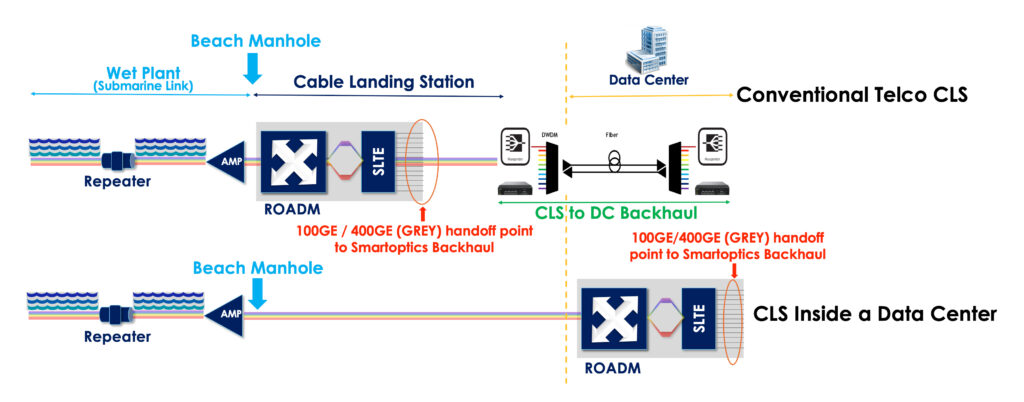

Infrastructure that connects Subsea Cable to CLS, including the marine steel directional bores and the Beach Manhole (BMH)

Cable operator is responsible for building and maintaining these equipment, SLTE & PFE, including getting all the necessary permits. These equipment make up the Fronthaul network.

The Backhaul network connects the CLS to data centers further inland. The length of the backhaul determines how quickly data traffic can reach end users, which means there is great value in ensuring a quick, efficient backhaul with the lowest latency

3 Different Types of Cable Landing Station Deployment Models

High capacity DCI solutions, offering encryption, low latency and easy scalability.

Conventional
Telco CLS

Facilities are built and operated by traditional telco providers

CLS Inside
a Data Center

Facilities are built to serve
as both CLS and Data Center

Modular CLS
in Industrial grade Building

Advantages of building a CLS in an existing modern Data Center are clear

Phase #1:
Process for Obtaining Approvals & Permits


for Deployment of Subsea Cable into Singapore​

To obtain a license for a Cable Landing Station (CLS) in Singapore, applicant needs to engage with the Info-comm Media Development Authority (IMDA)​. IMDA is the primary regulatory authority for telecommunications and media in Singapore

​
Here are general overview of the process:

  • Company needs to obtain an FBO license from IMDA​
  • This license allows applicant to deploy and operate telecommunications networks, systems, and facilities to provide telecommunication or broadcasting services outside of your own property boundaries​
  • This license is crucial for setting up a CLS and operating the associated infrastructure
1. After securing the FBO license, the applicant must seek approval from MPA, which includes a route study to identify the optimal marine path for the cable​

2. This step involves submitting detailed plans that align with designated marine cable corridors

​4. Application to MPA (Committee for Marine Projects) for submarine cable corridor and installation approval

​5. Application to Singapore Land Authority (SLA) for Wayleave and Temporary Occupational licences

Phase #2:
Subsea Cable Landing Stations Key Requirements​​

Subsea Cable Landing Station (CLS) requires regulatory authorization for operation within Singapore. CLSs are facilities on land where subsea fiber cables that cross oceans and connect continents come ashore. It allows data to flow between the submarine cable and mainly data centers nowadays ​
​
The license is issued by IMDA in Singapore to ensure that the operator complies with security, data, and regulatory requirements

​
Key Points of a Subsea Cable Landing Station License

Ownership & Operation:

It grants the operator permission to establish, manage, and operate the landing station infrastructure, which often includes specialized facilities for handling international communications​

Data and Network Security

Operators must meet strict requirements related to national security, data privacy, and network resilience. This is especially important due to the critical role of undersea cables in international data transmission​

International Coordination

Since subsea cables are international infrastructure, the license often requires coordination with regulatory bodies and adherence to international agreements, especially around cybersecurity​

Fees and Compliance

Operators might be subject to annual license fees and must regularly report and undergo inspections to ensure ongoing compliance

Subsea Cable Landing Stations Key Requirements

Obtaining a subsea cable landing station license can be a complex process, involving several challenges due to the critical nature of subsea cable infrastructure. Here are some of the main challenges:
Multinational Coordination: Subsea cables span international borders, so operators must navigate the regulatory requirements of multiple countries, which can have different rules regarding foreign ownership, licensing procedures, and cybersecurity requirements

National Security Requirements: Many countries impose strict security requirements for landing stations due to concerns over data privacy, interception risks, and national security. Compliance with these regulations often requires cooperation with intelligence and security agencies, adding complexity to the approval process

Environmental and Local Regulations: Coastal and environmental regulations can also pose challenges, as laying subsea cables and establishing landing stations can impact marine ecosystems and coastal areas, requiring extensive environmental assessments and permits
Land Acquisition and Facilities Development: Finding suitable coastal land for a landing station can be difficult due to geographic limitations and high real estate costs in desirable locations. Additionally, facilities must meet specific technical standards for connectivity, power, and security

Network Redundancy and Resilience: Operators must design landing stations to ensure high resilience, often requiring redundant infrastructure to handle potential failures or attacks. This can add to the cost and complexity of the project

Specialized Equipment and Expertise: Building and maintaining a cable landing station requires advanced technical expertise and equipment to handle large-scale fiber-optic data transmission and ensure network reliability, adding to operational costs and logistical challenges.
Cost of Cable Deployment and Maintenance: The cost of laying subsea cables and setting up landing stations is enormous, often requiring investments from multiple stakeholders. Maintenance costs are also high, as repair of subsea cables requires specialized ships and equipment

Financing Challenges: The need for extensive funding often requires partnerships or consortiums, but aligning the interests of multiple stakeholders can be challenging and time-consuming. Infrastructure and Technical Requirements

Land Acquisition and Facilities Development: Finding suitable coastal land for a landing station can be difficult due to geographic limitations and high real estate costs in desirable locations. Additionally, facilities must meet specific technical standards for connectivity, power, and security

Network Redundancy and Resilience: Operators must design landing stations to ensure high resilience, often requiring redundant infrastructure to handle potential failures or attacks. This can add to the cost and complexity of the project

Specialized Equipment and Expertise: Building and maintaining a cable landing station requires advanced technical expertise and equipment to handle large-scale fiber-optic data transmission and ensure network reliability, adding to operational costs and logistical challenges
Competitive Landscape: Telecom operators may face competition for access to landing stations in strategic locations, especially when large telecom companies dominate key regions, potentially creating monopolistic situations

Access and Capacity Sharing:
Some countries mandate that landing stations allow access to multiple operators to promote fair competition. Complying with these access-sharing requirements can limit operational control and affect profitability
Risk of Cybersecurity Breaches: Subsea cables carry significant volumes of international data, making them potential targets for cyber threats, espionage, and physical attacks. Operators must invest in cybersecurity to protect data integrity

Physical Security Risks: Beyond cyber threats, cable landing stations are vulnerable to physical disruptions, such as natural disasters and intentional sabotage. Ensuring physical security and contingency plans for these risks can be costly
Geopolitical Tensions: Diplomatic tensions between countries can impact cable deployment and landing station licensing, especially if foreign companies or governments are involved in funding or operating the infrastructure

Policy Changes and Restrictions: Regulatory policies can change, potentially restricting foreign ownership or imposing new data privacy requirements. For example, some countries impose data localization requirements, requiring certain data to be stored domestically, which may impact cable and station usage
Impact on Marine Ecosystems: Cables laid on the ocean floor can disrupt marine habitats, leading to concerns from environmental agencies and local communities

Sustainable Operation Requirements: Increasing emphasis on sustainability may require operators to adopt green technologies or implement practices that reduce the carbon footprint of their operations, potentially increasing project costs
Overall, establishing a subsea cable landing station is a major undertaking that requires navigating complex regulatory, financial, technical, and environmental challenges.

Why Do Enterprises Choose GOIP

Five evidence points around a central mark: continuous coverage, certification, regional footprint, single accountability path and operating history
The collection of the country’s most advanced cloud computing, on-premises server and network operation technology experience.
We have data centers in Hong Kong and Asia Pacific Region. The GOIP is a licensed SBO in Hong Kong , owns Value-Added Telecommunication Business Operation Licenses in Singapore and FCC Section 214 License in US.
We provide a variety of telecom services including Global Internet DIA, MPLS VPN solutions, Dwdm, SOC Security Operation Center, NOC Network Opeartion Center, Managed SD Wan services, Cloud Connectivity, Global Data Centre facilities, Data backup / migration and System Integration for small and large corporate communities.
With enhanced backbone functionality, scalability, stability, manageability and fault tolerance, integrates the state-of-the-art Internet Data Centers and a meshed network of PoPs situated in strategic cities across APAC & Mainland China, collectively serving more than 100 highly developed cities in the region.
Experienced senior management in cloud and on-premises platform management with overseas experience as senior advisor providing consultation  for latest technology
We provide 24/7/365 professional technical support and customer service with our NOC & SOC Team in APAC.
GOIP serves carriers and multinational companies in Asia Pacific regions, providing innovative and comprehensive networking solutions to customers to achieve their business objectives.

Ready to Elevate Your Business with GOIP’s Managed Services?

Future-proof your organization with managed SD-WAN and infrastructure solutions that ruthlessly prioritize security, agility, and performance.

Partner with GOIP to achieve guaranteed business continuity.

Contact our enterprise experts today for a complimentary consultation.
Please enable JavaScript in your browser to complete this form.
Loading
Facebook Instagram Linkedin

Telecom Services and Solutions

  • Dedicated Internet Access (DIA)
  • IP Transit
  • Cloud Direct Connect
  • DCI & Wavelength
  • International Ethernet Private Line (IEPL)
  • Dense Wavelength Division Multiplexing DWDM
  • Software Defined Metro(SDM)
  • Cable Landing Station Solutions
  • Smart Tower
  • IT Asset Disposition (ITAD)
  • Data Centre Relocation
  • Smart Hands 
  • Install, Move, Add and Change (IMAC)

  • Network Operations Center (NOC)
  • AIOps

GOIP

  • Join Us
  • Terms & Conditions
  • NDA & MSA
  • Service Level Agreements
  • Global Coverage
  • DCI Coverage
  • News

GOIP OFFICE

  • [email protected]
  • Singapore: (65) 6011 6288
  • Malaysia: (60) 3 2700 7929
  • Hong Kong: (852) 2138 9388
  • Taiwan: (886) 2 7731 0328
  • goipgroup.com.tw
  • USA: (1) 916 400 9996
  • goipglobalnet.com

© 2026 GOIP

Scroll to top
GOIPLogo Header Menu
  • Home
  • Connectivity
    • Dedicated Internet Access (DIA)
    • IP Transit
    • DCI & Wavelength
    • International Ethernet Private Line (IEPL)
    • Cloud Direct Connect
  • Network Infrastructure
    • DWDM
      • Webscale Cloud Solutions
      • Open Optical Solutions
      • DWDM & OTN Solution
    • Software Defined Metro (SDM)
    • Cable Landing Station Solutions
    • Smart Tower
  • IT Services
    • IT Asset Disposal
    • DC Relocation
    • On-site Support
    • IMAC Support
    • IT Deployments
  • Managed Services
    • Network Operations Managed Services (NOCaaS)
    • AIOps
  • Our Network
    • Global Coverage
    • DCI Coverage
  • About
    • News
    • Careers
    • Contact
  • Home
  • Connectivity
        • Dedicated Internet Access (DIA)Empower Your Global Enterprise with Guaranteed Bandwidth, Bespoke Connectivity, and Proactive 24/7 Technical Engineering.
        • IP TransitOur IP Transit product offerings with interactive maps and explore GOIP’s extensive network coverage.
        • Cloud Direct ConnectSecure, High-Performance Private Cloud Connectivity
        • DCI & WavelengthHigh-speed, low-latency data center interconnectivity powered by dynamic bandwidth and carrier-grade redundancy
        • International Ethernet Private Line (IEPL)Enable Global Scalability with GOIP’s Dedicated Connectivity Solutions
  • Network Infrastructure
        • DWDMFlexible, Future-Proof Open Line Systems for DCI and Metro Networks Supporting IP-over-DWDM.
          • Webscale Cloud Solutions
          • Open Optical Solutions
          • DWDM & OTN Solution
        • Software Defined Metro (SDM)SDM (Software Defined Metro) is an evolutionary networking solution that transcends the limitations of legacy infrastructure.
        • Cable Landing Station SolutionsOur infrastructure connects subsea cables to CLS, featuring marine steel directional bores and BMH.
        • Smart TowerReal-Time Tower Structural Monitoring Smart Tower gives you 24/7 visibility into tower health
  • IT Services
        • IT Asset DisposalEnsure data security and environmental responsibility with our end-to-end ITAD services.
        • DC RelocationWe manage the complex physical relocation of your critical IT infrastructure
        • On-site SupportExtend your IT team’s reach with our advanced on-site technical support
        • IMAC SupportMaintain optimal IT performance through structured Install, Move, Add, and Change (IMAC) support.
        • IT DeploymentsFrom workstation rollouts to enterprise-wide software and system implementations
  • Managed Services
        • Network Operations Managed Services (NOCaaS)Combines intelligent event correlation, rapid impact assessment, and prioritized incident resolution.
        • AIOpsOne AIOps platform across every brand of network
  • Our Network
        • Global CoveragePartner with us for Carrier-grade connectivity solutions that overcome physical limitations, delivered with regional knowledge.
        • DCI CoverageExpand seamlessly across Singapore, Malaysia and Hong Kong.
  • About
        • NewsIT Trends & Insights | GOIP’s Blog
        • CareersEmpowering Enterprise Connectivity Across APAC & Emerging Markets
        • ContactConsult with our senior engineers to architect a resilient, high-performance network tailored to your global footprint.